A Screen of Their Own: The Distinct Visual Theology of Polish Orthodox Iconostases in America
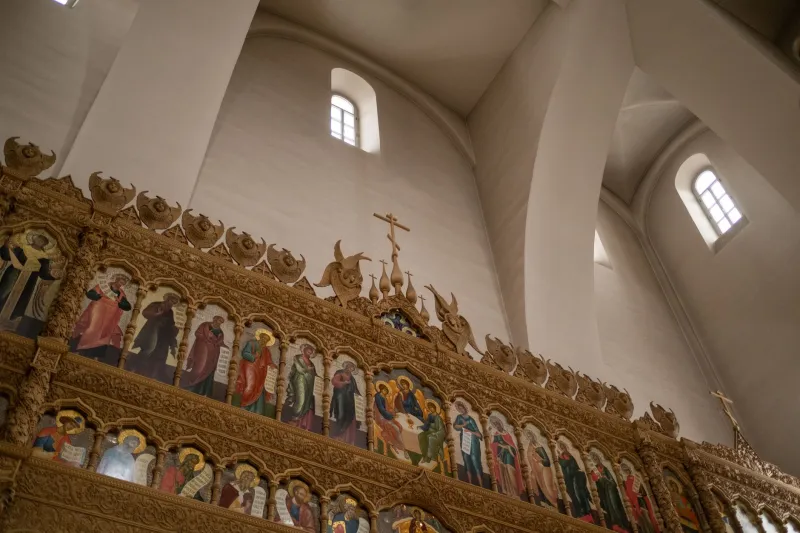
Walk into an Orthodox church in any American city and your eyes will immediately be drawn forward — toward the iconostasis, that luminous wall of sacred images separating the nave from the altar. For most American visitors, the association is almost automatic: the iconostasis is Russian, or perhaps Ukrainian, its gold leaf gleaming with Byzantine authority. What few recognize is that there exists a third tradition, older in some respects than either of those associations, and shaped by a geography and a history that produced something visually and theologically distinctive. That tradition belongs to the Polish Orthodox Church, and its icon screens tell a story that has been quietly waiting to be read.
Where East Meets West — and Negotiates
To understand why Polish Orthodox iconostases look different, one must first understand where Poland sits in the religious and cultural geography of Europe. For centuries, the Polish lands occupied a contested boundary between Latin Christianity and the Byzantine East. The Orthodox faithful in those territories — particularly in the regions of Podlachia, the Białystok area, and the Chełm Land — developed a visual culture that absorbed influences from both directions without surrendering to either.
The result is an iconostasis that tends to be lower and more open than its Russian counterpart. Where Russian screens often rise to extraordinary heights, filling the entire wall with tier upon tier of sacred imagery, Polish Orthodox screens frequently employ a more restrained vertical scale. The effect is less monumental and more intimate — an invitation rather than a proclamation. Scholars of Eastern Christian art have sometimes described this quality as a kind of sacred accessibility, though that phrase risks oversimplifying what is in fact a deliberate theological statement about the relationship between the worshipping community and the hidden mysteries of the altar.
The Influence of Gothic Carving and Baroque Ornament
Perhaps the most immediately visible distinction is the woodcarving that frames Polish Orthodox icon screens. Russian iconostases typically employ gilded architectural columns in a style derived from Byzantine and later Muscovite court aesthetics. Ukrainian screens, particularly those from the Galician tradition, often feature exuberant Baroque ornamentation that reflects the artistic ambitions of the Cossack Hetmanate period.
Polish Orthodox carving draws from a different well. The oak and linden wood frames found in historic churches in Podlachia and the Suwałki region show the hand of craftsmen who were equally familiar with the Gothic tracery of Catholic parish churches and the foliate ornament of Orthodox monastic workshops. The result is a hybrid visual grammar — pointed arches softened by Byzantine roundness, grapevine motifs intertwined with what appear to be Western heraldic flourishes. It is, in the truest sense, a border art.
Iconographer Marek Zielonka, who operates a studio in central Pennsylvania and has produced screens for three Polish Orthodox parishes in the northeastern United States, describes the tradition with careful precision. "When I study the historical photographs of the old churches in Hajnówka or Bielsk Podlaski, I see something that does not fit neatly into any textbook category," he explains. "The faces in the icons carry a Byzantine stillness, but the frames around them breathe with something more Western. It is not a compromise. It is a synthesis that took centuries to achieve."
The Faces on the Screen: Iconographic Style and Saintly Emphasis
Beyond architecture and ornament, the icons themselves reveal the distinctiveness of the Polish Orthodox tradition. The color palette tends toward cooler, more muted tones than the warm ochres and deep reds associated with Russian iconography. Blues and greens appear with greater frequency, and the treatment of faces — particularly in depictions of the Theotokos — shows a delicacy of line that some art historians have attributed to the influence of Polish miniature painting traditions.
Equally significant is the selection of saints represented. Polish Orthodox iconostases frequently feature figures who are either absent from or peripheral to Russian and Ukrainian screens: Saint Grzegorz the Wonderworker of Neocaesarea venerated under his Polish name, the Martyrs of Podlachia, and local bishop-saints whose cults were particular to the Orthodox communities of the Polish-Lithuanian Commonwealth. In American parishes, the inclusion of these figures serves a function that is simultaneously liturgical and cultural — it is a way of asserting that Polish Orthodoxy is not a regional variant of Russian Orthodoxy but a tradition with its own hagiographic landscape.
Preserving the Tradition in American Parishes
The challenge facing Polish Orthodox communities in the United States is considerable. Many American parishes that were founded by Polish immigrants in the early twentieth century gradually adopted iconostases produced by Russian or Greek workshops, simply because those were the resources available at the time. The visual distinctiveness of the Polish tradition was absorbed into a generalized Orthodox aesthetic that, while beautiful, erased the particular.
A deliberate reversal of that process is now underway in several communities. At a parish in New Jersey, a recently completed iconostasis was produced in consultation with researchers at the Polish Institute of Arts and Sciences of America, who provided archival photographs of pre-war churches in the Białystok region. The resulting screen incorporates the lower, more open proportions of the historical Polish model, along with carved oak frames based on documented examples from the nineteenth century.
Iconographer Anna Kowalczyk, who trained in Warsaw before immigrating to the United States and now teaches iconography workshops in the Mid-Atlantic region, speaks about the project with evident conviction. "Every time a Polish Orthodox parish installs a screen that could belong to any Orthodox church anywhere, something is lost," she says. "Not because those screens are not beautiful — they are. But beauty is not the only criterion. Identity is also a criterion. Memory is a criterion."
What the Screen Teaches
The iconostasis is not merely a decorative feature of an Orthodox church. It is, in the theological understanding of Eastern Christianity, a boundary that is also a threshold — a place where heaven and earth are simultaneously separated and joined. What hangs on that screen, how it is carved, how high it rises, and whose faces appear within its frames are not aesthetic preferences. They are confessions of faith embedded in wood and pigment and gold.
For Polish Orthodox Christians in America, insisting on the distinctiveness of their iconostasis tradition is therefore an act of theological seriousness as much as cultural preservation. It is a way of saying that the faith they inherited was shaped by a specific history, a specific geography, and a specific community of believers whose experience of Orthodoxy was neither Russian nor Ukrainian but irreducibly Polish.
That insistence, expressed quietly in parish halls and iconographer's studios across the northeastern United States, is building something that future generations will be able to see — literally — when they walk through the doors of their churches and lift their eyes toward the screen.