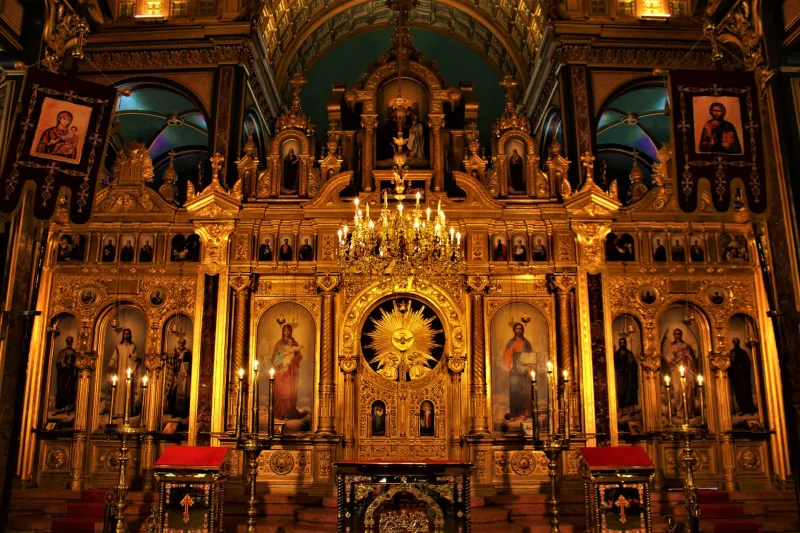
Roots in Exile: How Polish Orthodox Christians Built a Sacred America
America has long celebrated its identity as a nation of immigrants, yet certain stories remain stubbornly obscured beneath the weight of more dominant narratives. The history of Polish Orthodox Christians in the United States is precisely such a story — layered, complex, and profoundly moving. It is a history shaped not merely by economic ambition, as with so many immigrant groups, but by religious persecution, political upheaval, and an unshakeable fidelity to a faith that the modern world has struggled to categorize.
At Cerkiew America, we believe these stories deserve not only to be told, but to be preserved with the care and reverence they warrant.
The Tsarist Shadow: Faith Under Pressure
To understand why Polish Orthodox Christians came to America, one must first understand the world they left behind. The territories that composed historical Poland were, for much of the nineteenth century, partitioned among three imperial powers: Russia, Prussia, and Austria. For Orthodox Christians living within the Russian partition, the relationship with the Tsarist state was paradoxical. While Orthodoxy was the official religion of the Russian Empire, ethnic Poles who practiced the faith occupied an uneasy position — Orthodox in theology, yet culturally and linguistically distinct from Russian imperial identity.
The situation grew considerably more fraught following the failed uprisings of 1830 and 1863. Tsarist authorities, viewing Polish national consciousness as inherently subversive, imposed sweeping Russification policies across the region. Polish-language liturgy was suppressed. Clergy who maintained distinctly Polish customs faced harassment, exile, or worse. Entire communities found themselves caught between Roman Catholic neighbors who regarded them with suspicion and an Orthodox hierarchy that sought to absorb them into a Russian ecclesiastical framework that felt foreign to their souls.
For many, emigration was not a choice so much as a form of spiritual survival.
The Atlantic Crossing and Early Settlements
The first significant arrivals of Polish Orthodox immigrants to the United States occurred in the latter decades of the 1800s, coinciding with the broader Eastern European migration that reshaped American cities. Unlike their Roman Catholic compatriots, who were absorbed into an already robust Polish-American Catholic infrastructure, Orthodox Poles often arrived to find no existing institutional framework awaiting them.
They settled where industrial labor was plentiful: Pennsylvania's coal regions, the steel towns of Ohio, the textile mills of New England. In communities such as Scranton, Youngstown, and later the neighborhoods of South Brooklyn, these families gathered in private homes to celebrate Divine Liturgy, often relying on itinerant priests who traveled circuits between scattered congregations.
One of the earliest formally organized Polish Orthodox parishes in America was established in the anthracite coal belt of northeastern Pennsylvania in the 1890s. Archival records from the Orthodox Church in America document several such communities emerging in that era, typically listed under Slavic or generically "Russian" designations that obscured their specifically Polish character — a bureaucratic erasure that would complicate historical recovery efforts for generations.
Brooklyn: A Cathedral in a New Canaan
By the early twentieth century, New York City had become the gravitational center of Polish Orthodox life in America. Brooklyn, in particular, offered the density of community and the proximity of port employment that made it attractive to newly arrived families. The borough's neighborhoods of Greenpoint and Williamsburg became home to small but vibrant parishes where the Polish language was preserved in both liturgy and daily conversation.
What distinguished these Brooklyn communities from their counterparts elsewhere was a conscious effort to maintain what scholars of Eastern Christianity have called "dual fidelity" — a commitment both to Orthodox theological tradition and to Polish cultural expression. Icons were commissioned from Polish craftsmen. Parish feast days incorporated folk customs rooted in the Mazovian and Podlasian regions of Poland. Church choirs sang liturgical texts in Church Slavonic alongside Polish-language hymns that grandmothers had carried across the Atlantic in memory alone.
These were not museums of nostalgia. They were living communities navigating the tension between preservation and adaptation that every immigrant faith community must confront.
Voices Across Generations
Descendants of these original settlers speak of their heritage with a mixture of pride and poignant awareness of what has been lost. Maria Kowalczyk, whose grandparents emigrated from the Białystok region in the 1920s and eventually settled in the Greenpoint section of Brooklyn, describes attending Sunday services as a child in a parish that felt unlike anything her schoolmates could comprehend.
"We were Polish, but we were not Catholic," she recalls. "We were Orthodox, but we were not Russian. People simply did not have a category for us. Even other Polish Americans would look at us strangely. But inside that church, we knew exactly who we were."
Her testimony echoes that of many descendants who maintain that the parish community served functions far beyond the strictly religious. It was a legal aid society, an employment network, a repository of collective memory, and a bulwark against the assimilationist pressures that gradually eroded so many immigrant identities.
Andrzej Pasternak, a third-generation parishioner at a small Orthodox church in central Pennsylvania whose congregation traces its roots to the 1890s coal mining era, notes that his community has recently undertaken a formal effort to document its history before the last living links to the founding generation are gone.
"We found baptismal records going back to 1897," he says. "Names that were Polonized, then Americanized, then sometimes Polonized again. You can read the entire history of this community in how people chose to name their children."
Preservation in the Digital Age
The work of historical recovery is ongoing. Organizations dedicated to Eastern Christian heritage in America have begun digitizing parish records, oral histories, and liturgical artifacts that might otherwise be lost to institutional indifference or simple physical decay. Cerkiew America is proud to support these efforts, recognizing that the preservation of this heritage is not merely an act of cultural sentiment but a theological imperative.
For Orthodox Christians, the communion of saints is not a metaphor. It is a living reality. To remember the faithful who came before — who crossed oceans carrying their faith like an ember shielded from the wind — is to participate in that communion. The Polish Orthodox Christians who built their churches in Pennsylvania mining towns and Brooklyn tenement neighborhoods did not do so for posterity. They did so because they believed the Liturgy must be celebrated, the sacraments must be received, and the community of the faithful must be gathered, regardless of the cost.
Their descendants, scattered now across the American continent, carry that conviction forward. And in the telling of their story, perhaps the broader American public can come to understand that the diversity of this nation's religious landscape is far richer, and far older, than the familiar narratives suggest.