After the Crown Falls: Polish Orthodox Ecclesiastical Courts and the Mercy of a Second Marriage
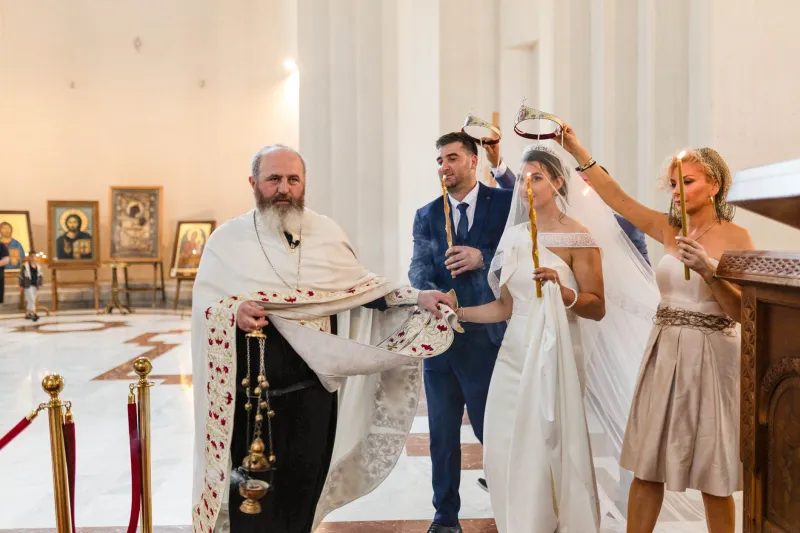
In the Orthodox marriage rite, the crowning of the bride and groom is not merely symbolic. The crowns — heavy, ornate, held above the heads of the couple by sponsors — represent the weight of a kingdom being established before God. They also represent martyrdom: the willingness to suffer for one another, to die to self in the daily work of a shared life. When that life ends not in death but in divorce, the theological consequences are profound, and the pastoral questions that follow are among the most difficult any bishop or priest must confront.
For Polish Orthodox communities in the United States, those questions are arriving with increasing frequency. The divorce rate among American Orthodox Christians, while lower than the national average by most estimates, has risen steadily over the past three decades. Remarriage petitions — formal requests submitted to diocesan ecclesiastical courts asking for permission to enter a second or, in rare cases, third canonical union — now represent a significant portion of the administrative work of Polish Orthodox chanceries.
How those petitions are handled, and on what theological grounds, reveals much about the current state of Orthodox pastoral practice in America.
What the Canons Permit — and What They Do Not
The Orthodox Church's approach to divorce and remarriage is frequently misunderstood, both by outsiders and by the faithful themselves. It is neither the absolute prohibition of Roman Catholicism nor the casual accommodation of most Protestant denominations. It occupies a distinct canonical and theological space that defies easy categorization.
The Church does not recognize divorce as dissolving a sacramental marriage in the way that an annulment claims to retroactively void one. Rather, it acknowledges — with sorrow, not approval — that a marriage may have died: that the living reality of the union, the koinonia of two persons becoming one flesh before God, has been extinguished. On this basis, and following the exception clause of Matthew 19, the Church has historically permitted a second marriage, though with a ceremony of notably more penitential character than the first. A third marriage is permitted only in extraordinary circumstances. A fourth is categorically prohibited.
The process by which these permissions are granted falls to the diocesan bishop, who typically delegates the initial investigation to an ecclesiastical court or tribunal. In Polish Orthodox jurisdictions in America, the structure and rigor of these tribunals varies considerably.
The American Complication
Several bishops and canonical scholars interviewed for this article identified a common pressure point: the influence of American cultural assumptions about individual fulfillment on the way petitioners frame their requests — and, increasingly, on the way some clergy respond to them.
"In American culture, the dominant narrative about divorce is that it is sometimes necessary for personal growth, for the health of the individual," observed one bishop serving a Polish Orthodox eparchy in the eastern United States. "That narrative has seeped into the Church. I see petitions now that read less like requests for pastoral mercy and more like arguments for an individual right. That is a very different thing."
The distinction he is drawing is not merely semantic. Orthodox theology does not recognize a right to remarriage. It recognizes the possibility of economia — the pastoral application of mercy in specific, discerned circumstances — as a concession to human weakness, not an affirmation of human autonomy. The difference between those two framings has significant implications for how a tribunal evaluates a petition.
At the same time, several priests working in parish ministry pushed back gently against what they described as an excessive rigidity in some chancery responses.
"I have sat with women who have survived genuinely abusive marriages," said one pastor in the Midwest. "They come to me after years of healing, with a serious Orthodox man who wants to marry them in the Church. The canonical process should be serious. It should involve genuine discernment. But it should not become a mechanism for keeping wounded people permanently excluded from sacramental life."
Inside the Tribunal
The mechanics of the ecclesiastical court process in Polish Orthodox jurisdictions typically begin with a formal written petition, submitted by the divorced party through their parish priest. The petition must include documentation of the civil divorce, a personal account of the marriage and its breakdown, and testimony — where available — from witnesses who can speak to the circumstances of the dissolution.
The tribunal then conducts its own inquiry, which may involve interviews with both parties and with the parish priest. The central question is not whether the marriage failed — the civil record establishes that — but whether the petitioner bears primary moral responsibility for that failure, and whether sufficient time and genuine repentance have intervened between the dissolution and the request for a new union.
In cases involving adultery, abandonment, or abuse, the path to permission for a second marriage is generally more straightforward. Cases involving what canonists call "mutual incompatibility" — the gradual erosion of a marriage without a single decisive moral breach — are more complex and tend to generate the most disagreement among tribunal members.
"The hardest cases are the ones where nobody did anything obviously wrong," acknowledged one canonical consultant who has advised multiple Polish Orthodox tribunals. "Two people grew apart. Both contributed to the failure. Both are now asking for another chance. The canons give us principles, but they do not give us algorithms."
The Second Marriage Rite and Its Witness
For those who receive permission, the second marriage ceremony itself carries a distinct theological weight. Unlike the first marriage rite, which is entirely celebratory in character, the second rite includes penitential prayers, the omission of certain joyful elements, and an explicit acknowledgment of the failure of the previous union. Some petitioners find this difficult. Others describe it as deeply meaningful — a liturgical honesty about the complexity of their lives that they did not expect to find in a religious ceremony.
"I was not expecting to weep during the penitential prayers," said one woman, a Polish Orthodox parishioner in Pennsylvania who remarried within the Church after a decade-long first marriage ended in her husband's infidelity. "But I did. It felt like the Church was acknowledging everything I had been through, not pretending it had not happened. That meant more to me than I can say."
Holding the Line Without Losing the Person
The challenge facing Polish Orthodox bishops in America is not, at its core, a canonical challenge. The canons exist. They are clear in their broad outlines, even where they require discernment in their application. The challenge is cultural and pastoral: how to maintain the theological integrity of a tradition that takes marriage with absolute seriousness, in a society that treats it as one lifestyle arrangement among many.
That challenge will not be resolved by loosening the canons to match American expectations. Nor will it be resolved by applying those canons with a rigidity that transforms mercy into bureaucratic obstruction. It will be resolved — to the extent it can be — by bishops and priests who understand both the tradition they are guarding and the people they are serving, and who refuse to sacrifice either for the convenience of the other.