Fasting at the Table of a Nation That Never Stops Eating: Polish Orthodox Lent in Modern America
A Sacred Rhythm Out of Step With the Secular Calendar
Every year, as Great Lent descends upon the Orthodox faithful, a particular tension settles into Polish-American households that no liturgical rubric fully addresses. The office potluck is scheduled for a Friday. The family birthday dinner falls during the first week of the fast. The neighborhood block party lands squarely in Holy Week. And the supermarket, with its fluorescent abundance, offers no obvious map for a soul trying to navigate strict abstinence from meat, dairy, fish, oil, and wine across forty days of an American spring.
For Polish Orthodox Christians — many of whom trace their ecclesiastical roots to communities that observed these fasts under conditions far more austere than a suburban cul-de-sac — the challenge is not theological doubt. The teaching is clear, the tradition is venerable, and the spiritual rationale is deeply understood. The challenge, rather, is practical, social, and in some ways cultural: how does one fast with integrity in a society that has elevated constant eating to the level of civic religion?
What the Fast Actually Demands
It is worth stating plainly what Orthodox fasting requires, because many Americans — including some who identify loosely with Christian traditions — have only the vaguest sense of what a serious Lenten fast entails. The Orthodox Great Lent is not the symbolic abstinence of a single meatless Friday. It is a sustained, structured, graduated discipline spanning six weeks, during which the faithful abstain from meat and dairy products entirely, restrict fish to certain permitted days, and on stricter days forgo oil and wine as well.
Father Aleksander Wiśniewski, a parish priest serving a Polish Orthodox congregation in western Pennsylvania, explains the purpose with characteristic directness. "Fasting is not a diet," he says. "It is a school of the will. When the body is disciplined, the soul becomes more attentive. That is why the Church has always guarded these periods with such care."
The challenge, he acknowledges, is that American food culture operates on premises almost perfectly opposed to this discipline. Convenience, abundance, and social eating are not merely habits in the United States — they are values. To refuse a slice of birthday cake or decline the cheese tray at a colleague's retirement party is, in many American social contexts, to commit a minor act of rudeness. For the Orthodox faithful, it is an act of devotion.
The Potluck Problem and the Parish Response
Parishes have not been passive in the face of these pressures. Across the country, Polish Orthodox communities have developed what might be called a fasting infrastructure — a network of practical resources, communal meals, and pastoral guidance designed to make the fast sustainable without making it socially catastrophic.
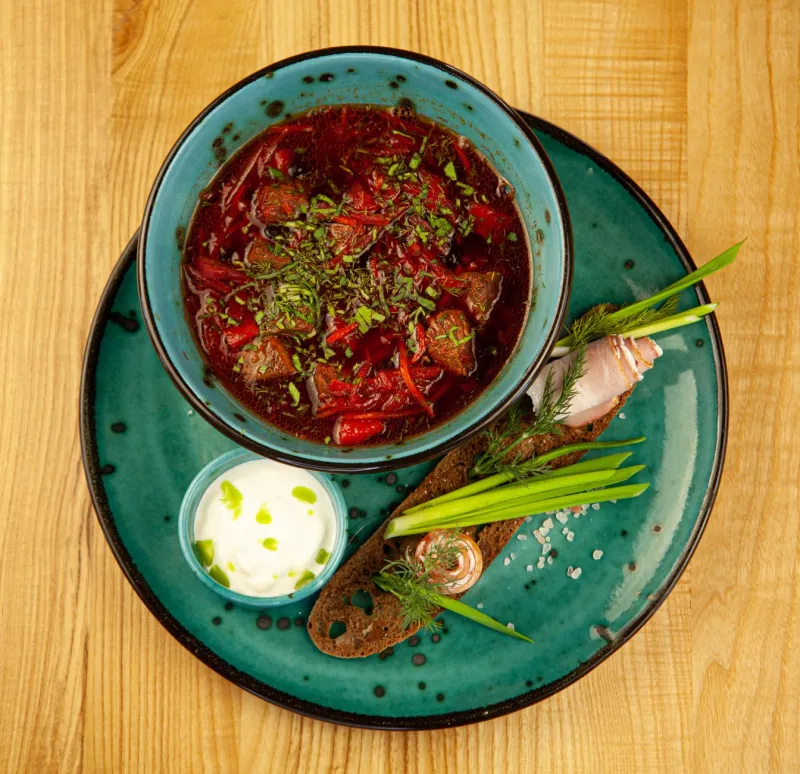
St. Paraskeva Orthodox Church in Chicago, Illinois, hosts what its parish council has dubbed "Fasting Fridays" throughout Great Lent — communal meals held after Presanctified Liturgy services, featuring traditional Polish Lenten dishes such as żurek made without the usual addition of hard-boiled eggs, beet soup, buckwheat with mushrooms, and various preparations of dried legumes. The meals serve a dual purpose: they provide the faithful with a satisfying, properly fasted dinner, and they create a social anchor that makes the discipline feel communal rather than isolating.
"People need to see that fasting food can be beautiful and nourishing," says Maria Kowalczyk, a longtime parishioner who coordinates the Friday meals. "When you put a bowl of proper barszcz in front of someone after a Presanctified Liturgy, they are not thinking about what they are missing. They are thinking about what they have been given."
Nutritional Wisdom and the Ancient Fast
The intersection of Orthodox fasting and contemporary American nutritional culture is, perhaps surprisingly, less fraught than it might appear. A growing number of registered dietitians have noted that the Orthodox fasting pattern — heavy on legumes, whole grains, vegetables, and seafood on permitted days — aligns reasonably well with dietary frameworks associated with long-term health. The Mediterranean diet, widely praised in American medical literature, bears a structural resemblance to the Orthodox Lenten table.
Dr. Joanna Pawlak, a registered dietitian of Polish descent who practices in New Jersey and attends an Orthodox parish, has worked with several families in her congregation to plan Lenten menus that satisfy both canonical requirements and sound nutritional principles. "The fast is not dangerous if it is approached thoughtfully," she says. "The difficulty is that Americans are not accustomed to cooking with legumes as a primary protein source. There is a learning curve. But the tradition itself is nutritionally quite sound."
She cautions, however, against treating the fast primarily as a health regimen. "The Church fasts for spiritual reasons. If someone is approaching Lent as a detox program, they have misunderstood the purpose entirely. The nutritional benefits are, at best, a secondary consequence of a discipline aimed at something much higher."
Children, Schools, and the Lunchroom Crucible
For Polish Orthodox families with school-age children, the fast presents its most acute social complications in the school cafeteria. American school lunch programs are not designed with Orthodox fasting in mind, and children who bring Lenten lunches — bean soup in a thermos, a piece of fruit, bread without butter — often attract the attention of curious or dismissive classmates.
Parents interviewed for this article described a range of approaches. Some pack lunches that are technically Lenten but visually unremarkable — hummus with vegetables, peanut butter on whole-grain bread on permitted days — to minimize social friction. Others use the lunchroom as an occasion for catechesis, encouraging their children to explain the fast to interested classmates.
"My daughter is twelve," says one mother from a parish in New Jersey. "She knows what she believes and why she fasts. She has had to explain it to her friends many times. I think it has actually strengthened her faith. When you have to articulate something, you understand it more deeply."
Father Wiśniewski endorses this approach with pastoral warmth. "We do not fast to hide," he says. "We fast to be transformed. If that transformation becomes visible to our neighbors, that is not a problem to be solved. It is an opportunity for witness."
Holding the Line Without Building a Wall
The deeper question animating all of these practical discussions is one of identity and integration. Polish Orthodox Christians in America are not monastics. They live, work, and raise families within the full complexity of American society. The fast is meant to be a discipline of engagement with God, not a mechanism of withdrawal from the world.
The most pastorally mature voices in these communities consistently resist two equal and opposite errors: the rigorism that uses fasting as a form of social superiority, and the laxity that abandons the fast whenever it becomes inconvenient. The tradition, they argue, offers sufficient flexibility — through economia, the pastoral principle by which bishops and priests may make accommodations for genuine necessity — without ever surrendering the underlying discipline.
"The fast is a gift," Father Wiśniewski says, in words that capture the spirit of these communities at their best. "It is not a burden to be endured or a rule to be gamed. It is a form of love — love for God, love for the tradition, love for the community that has kept this way of life across centuries. When we fast together, we are joined to every Polish Orthodox Christian who fasted before us. That is not isolation. That is communion."
In the end, the potluck will go on without the cheese plate. The birthday dinner will be navigated with grace and a quiet explanation. And the faithful will arrive at Pascha having kept the fast — not perfectly, perhaps, but sincerely — and find that the feast tastes all the sweeter for it.