A Calendar Made of Fruit: The Quiet Theology of the Polish Orthodox Pantry
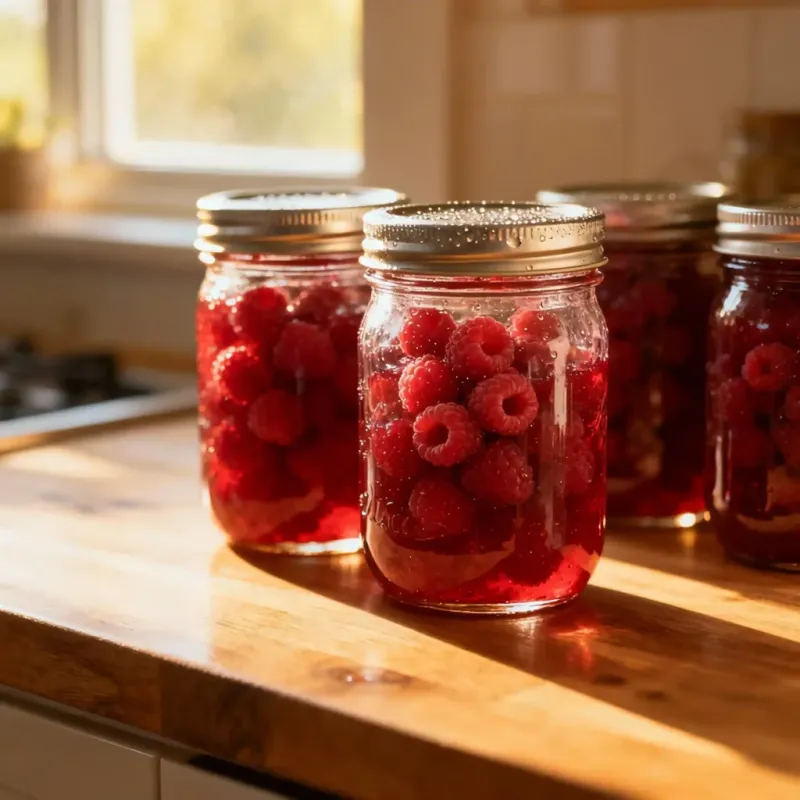
Photo: grandmother canning raspberry jam preserves kitchen jars, via www.tasteourdish.com
In a modest kitchen in Parma, Ohio, Helena Wisniewska keeps two calendars on her refrigerator. One is the glossy magnetic kind, printed by an insurance company, crowded with dentist appointments and school holidays. The other is a small paper icon calendar from her parish, its feasts and fasts marked in red and gold. Only one of them, she insists, tells her what day it actually is.
"The American calendar asks what you have to do," she says, stirring a pot of raspberry preserves the way her mother did in Podlasie sixty years ago. "The Church calendar asks what you are preparing for. Those are very different questions."
The Blessing of the First Fruits
Every August, on the Feast of the Transfiguration, Orthodox Christians bring baskets of grapes, apples, berries, and honey to church for the blessing of first fruits — an ancient custom that Polish households carried with them across the Atlantic. In villages, the ritual once marked the point at which the season's harvest could finally be eaten. In American suburbs, it marks something subtler: an acknowledgment that food, and the time it takes to grow and preserve it, are not merely commodities.
For Mrs. Wisniewska and countless homekeepers like her — second- and third-generation Polish-Americans from Chicago's Northwest Side to the anthracite towns of Pennsylvania — the pantry is an extension of the sanctuary. Strawberries set aside in June become the dessert for a feast day in July. Mushrooms dried in autumn wait for the Christmas Eve supper of Wigilia. The shelf itself becomes a kind of liturgical map, each jar a small remembrance of a season the fast has already passed through.
What Burnout Cannot Give
Sociologists have written at length about American hurry — the compression of life into productivity, the erosion of seasonal rhythm. The Orthodox tradition answers with something almost stubbornly old-fashioned: a year that breathes. Fast and feast. Sowing and harvest. Dormition and Nativity. The liturgical calendar does not accelerate when life gets busy, and it does not apologize for inconvenience.
This is not nostalgia for its own sake. It is a theology of time. The Church teaches that time is not an empty container to be filled but a creation to be sanctified — and households that live by the liturgical year, even imperfectly, enact that teaching one jar of preserves at a time.
Maria Dabrowski, a third-generation Orthodox homekeeper in Bridgeport, Connecticut, puts it plainly. "My coworkers think it's charming that I fast and can jam and keep the feasts. What they don't see is that it's the only structure in my life I didn't invent myself. Everything else I can reschedule. The Church's year reschedules me."
A Countercultural Practice Hiding in Plain Sight
There is a lesson here for American families exhausted by their own calendars. The Polish Orthodox grandmother with her jam calendar is not practicing a hobby; she is refusing an anthropology — the idea that a person is only as valuable as the hours they produce. Her rhythm says that some days are for labor, some for rest, some for fasting, and some for feasting, and that confusing these is not efficiency but disorder.
Parishes are beginning to notice. A handful of Polish Orthodox communities have started hosting seasonal workshops — preserving days before the Dormition fast, honey blessings, Advent baking afternoons — drawing in young families, and not a few non-Orthodox neighbors, who arrive curious and leave quietly changed.
Helena Wisniewska is unimpressed by the novelty. "My grandmother did this in a village with no electricity," she says, sealing another jar. "Now it's countercultural. Fine. The raspberries don't care what century it is. They ripen when they ripen, and you either pay attention or you miss them."
Which may be, in the end, the whole of the teaching. Time, like fruit, does not wait. The liturgical year simply teaches the soul to be present when it does.