The Choir Loft Is the Battleground: Language, Melody, and the Soul of Polish Orthodox America
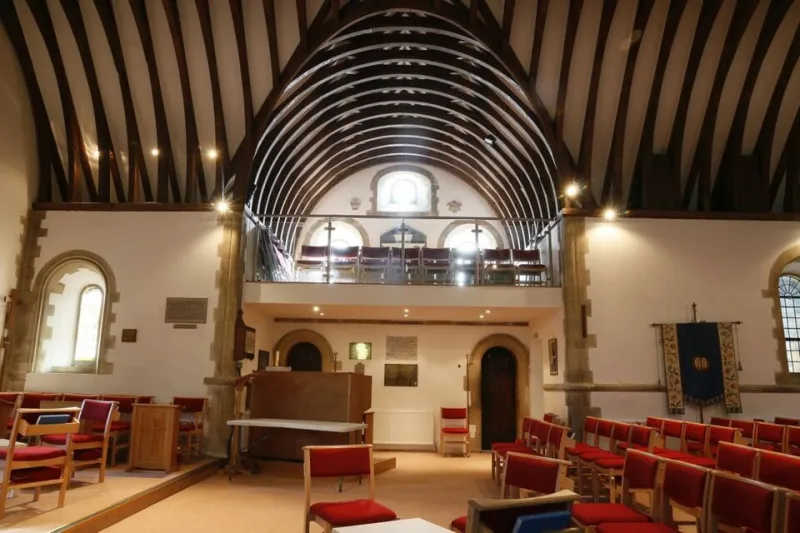
Photo: Bill Nicholls , CC BY-SA 2.0, via Wikimedia Commons
Ask a parish priest where the battles over identity are being fought in Polish Orthodox America, and he will likely change the subject to stewardship. Ask the choir director, and she will tell you exactly where the war is: twenty feet above the nave, in the loft, over the alto section.
It is there that the question every immigrant church eventually faces — what do we keep, what do we translate, and who decides? — gets rehearsed, note by note, every Thursday evening.
Three Repertoires, One Loft
Polish Orthodox parishes in America inherited a layered musical tradition. At the foundation sits Znamenny chant, the austere, unison melody of the Slavic Orthodox tradition, centuries old and unmetered. Layered onto it came the Polish hymnody of the Carpathian and eastern frontier villages — folk-inflected, harmonized in thirds, carrying the warmth of the kitchen and the field. And now, pressing in from below the loft, comes a third repertoire: English-language settings, often composed or arranged by second- and third-generation parishioners who love the tradition but pray in the language of their workplaces.
Each repertoire carries a claim. Znamenny chant says: we are Orthodox, and this is the sound of eternity. Polish hymnody says: we are the heirs of those who crossed the ocean with nothing and sang anyway. English settings say: we are not a museum, and the faith must live in the tongue our children dream in.
None of these claims is wrong. That is precisely the problem.
Why the Loft, Not the Pulpit
The pulpit, by convention and courtesy, has stayed diplomatic. Sermons drift toward the moral life; language politics are handled in committee. But the choir loft has no committee. Repertoire selection is a weekly act of ecclesiology, and everyone in the loft knows it.
Consider what is actually at stake in a single decision: whether the Cherubic Hymn is sung to the traditional Polish melody or an English setting. The Polish melody binds the service to Wilno and Warsaw, to grandparents now sleeping in the cemetery on the hill. The English setting binds it to the teenager in the third pew who will, in twenty years, either be here or not.
The directors I have spoken with describe their work with surprising passion. "I am not choosing songs," one veteran director in Pennsylvania told me. "I am choosing which memory of the Church my grandchildren will inherit."
Against Both Nostalgia and Amnesia
The easy temptation is to frame this as tradition versus modernity. The truth is subtler. Pure Znamenny revivalism, rigidly enforced, risks turning the parish into a heritage society with incense — revering a Poland that exists mostly in memory. Wholesale anglicization, on the other hand, risks a quieter loss: a second generation that belongs to Orthodoxy but to no particular community, no particular table, no particular grave it tends.
The healthiest parishes I have visited refuse the binary. They sing Znamenny at Liturgy, Polish hymns at festal vigils, English settings where they genuinely serve — and, crucially, they teach. A choir that explains why a melody matters creates parishioners who can carry it forward. A choir that merely performs it creates an audience that will, eventually, stay home.
The Sound of a Church Being Born
There is a reason the Church has never feared multiple musical languages; there are eight tones, after all, and the tradition has always sung the faith in the vernacular of the people — which is exactly what Polish was, once, in this country.
The quarrel in the choir loft, then, is not a pathology to be managed but a birth to be witnessed. What is being argued over, Thursday nights in lofts from Scranton to Chicago, is nothing less than the sound of a Church becoming American without ceasing to be itself.
May the altos win. All of them.