Zmarzłe Hymns and Kitchen Altars: The Five Songs That Raised a Generation of Polish Orthodox Children
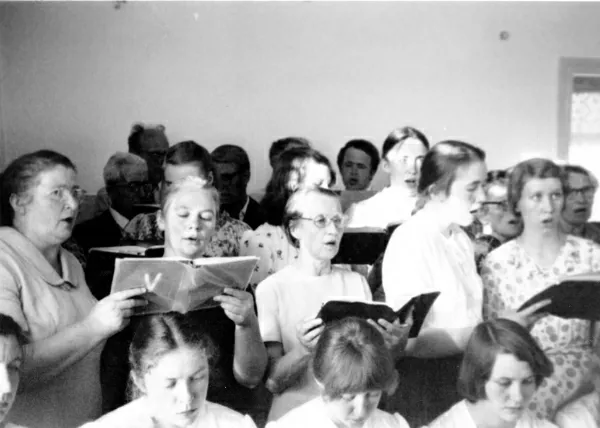
Photo: Mennonite Church USA Archives, No restrictions, via Wikimedia Commons
Theology is usually transmitted through books. In Polish Orthodox America, it was often transmitted through a soprano in the third pew who sang slightly ahead of everyone else, and a child beside her absorbing every note. Here are five hymns that functioned, for generations of American-born faithful, as their first encounter with the faith — along with the stories of how they got here.
1. "Cudowna Opatrzność" — The Hymn of the Ship's Hold
Every Polish Orthodox child knows the opening line of this hymn of providence, even if they cannot spell the title. Its melody is simple, almost folk-like, built to be sung unaccompanied in a space with no organ — which is exactly the condition in which it crossed the Atlantic.
Older parishioners in Chicago and Baltimore trace it to emigrant communities of the 1880s and 1890s, when the Orthodox movement among the Carpatho-Russian and Lemko workers of Pennsylvania needed songs that required no hymnals and no formal training. It was, in effect, a hymn designed for men with coal dust in their lungs. When a child asks why it sounds like something you could sing while walking, the answer is: because it is.
2. The Dormition Troparion, Sung "the Grandmother's Way"
Every jurisdiction has its official setting of the feast-day troparion. Polish-American parishes have that one, and then they have the version — the one with the slightly elongated second phrase, the one where the choir pauses a half-beat too long before "pobożnie."
That half-beat is a fossil. Ethnomusicologists who have recorded elderly choirs in both America and the Podlachia region of Poland have noted the same hesitation in village singing there, suggesting the American custom preserves a regional practice now vanished from the old country. Children who grew up hearing it often experience a small shock upon visiting a parish that sings the "correct" version. The grandmother's way, they learn, is the older way.
3. "Wielkie Imię Boże" — The Processional Workhorse
If a hymn could be nominated for sainthood by sheer frequency of use, this one would be canonized. It is the processional of Polish Orthodox America, sung at every outdoor cross procession, every cemetery blessing on Pascha, every parish anniversary where the choir loft is full and the air conditioning has failed.
Its power lies in its democratic construction: the melody sits squarely in the range of untrained voices, and the harmony, when the choir adds it, never outruns the melody. Several parishes credit it with keeping their processions alive at all — a hymn simple enough that a congregation of fifteen can sound like a congregation of fifty.
4. The Paschal Refrain Nobody Wrote Down
Ask a third-generation parishioner to name their favorite hymn and many will describe, rather than name, a joyful Paschal refrain sung in a mixture of Polish and Church Slavonic that no printed book seems to contain. It exists in perhaps a dozen handwritten notebooks, each slightly different, each jealously guarded by a choir director.
One such notebook, kept by a choir director in Cleveland for forty years, is currently being digitized by a graduate student who describes it as "a manuscript with grease stains and therefore a primary source." The refrain's origin is murky — possibly a village znamenny-derived melody, possibly a nineteenth-century composition absorbed into folk memory. What is certain is that for American children, this unnamed song is Pascha: the sound of candle wax and lilies and an aunt crying into her scarf.
5. The Lullaby That Is Secretly a Troparion
Perhaps the most tender entry on the list is not sung in church at all. In many Polish Orthodox households, mothers and grandmothers sang children to sleep with a soft, repetitive melody whose text, examined closely, turns out to be a paraphrase of a theotokion. It was never in any hymnal. It traveled in the one liturgical space the emigration preserved absolutely intact: the kitchen.
Musicologists have collected variants in parishes from Connecticut to Oregon, and the variants are close enough to suggest a single common source — probably a village in the Bug River region — but no one has located it. The hymn, like so much else, arrived without papers and made a life anyway.
Why the Melodies Matter
A conservative instinct in Orthodox life holds that the faith is preserved in its forms: the fasts, the prostrations, the melodies. These five songs suggest the instinct is correct. Doctrine was debated in the council halls; the melodies were believed in the pew. And the children who hummed along, decades ago, are now the parish council members and choir directors keeping the whole inheritance alive — one slightly ahead-of-the-beat soprano at a time.