When the Sermon Was a Battlefield: Language, Loyalty, and Ecclesiastical Power in Polish Orthodox Parishes, 1890–1950
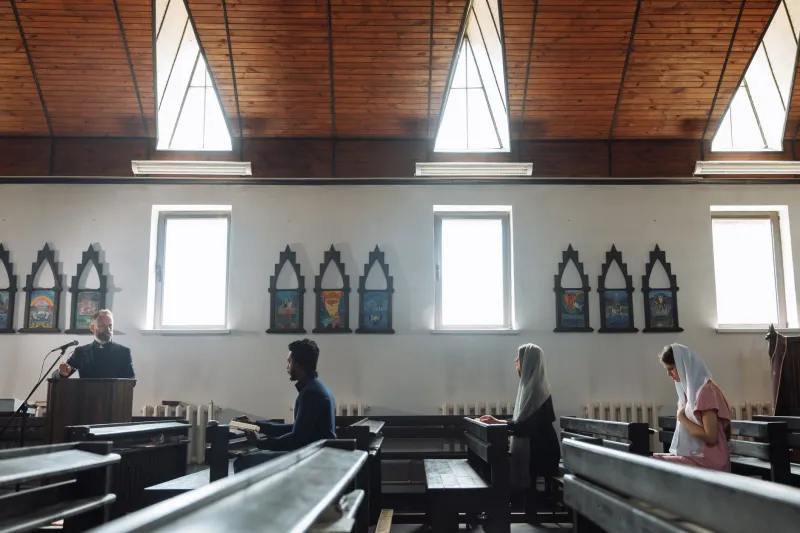
In the winter of 1913, a small Orthodox parish in the anthracite coal country of northeastern Pennsylvania found itself divided not over doctrine, not over the calendar, and not over the canonical disputes that so frequently fractured immigrant communities in that era. The congregation was divided over a sermon. More precisely, it was divided over the language in which that sermon had been delivered — and by extension, over who had the authority to decide such things in the first place.
The priest had spoken in Polish. His bishop had instructed him to speak in English.
That quiet act of liturgical defiance, replicated in parishes from Pittsburgh to Chicago to the mill towns of New England, encapsulates one of the most consequential and least examined conflicts in the early history of American Orthodox Christianity. Language was never simply a medium of communication for Polish Orthodox immigrants. It was a vessel of memory, a marker of communal sovereignty, and ultimately a site of theological contest.
The Immigrant Parish as a Fortress of the Mother Tongue
To understand why Polish-speaking parishioners fought so tenaciously to preserve their language within the Orthodox Church, one must appreciate what the parish represented to the first and second generations of Polish Orthodox immigrants. Arriving primarily between the 1880s and the 1920s, these men and women came predominantly from the Carpathian borderlands — regions where ethnic, linguistic, and religious identities had been contested by empires for centuries. They were accustomed to defending their heritage against powerful institutions that wished to absorb or erase it.
In America, the parish hall was more than a place of worship. It was a school, a community center, a lending network, and a cultural archive. The Polish language, heard in prayers, in hymns, in the priest's homily, and in the conversations that followed the Divine Liturgy, was the thread that stitched all of these functions together. To surrender the language was, in the perception of many parishioners, to surrender the community itself.
This was not mere sentiment. Sociological studies of immigrant religious communities conducted in the early twentieth century consistently found that parishes which maintained the heritage language of their congregation retained higher rates of youth participation, stronger intergenerational bonds, and more robust charitable activity. Language was not incidental to community vitality — it was constitutive of it.
The Hierarchy's Dilemma
The ecclesiastical authorities who oversaw Polish Orthodox parishes during this period faced pressures that were equally real, if differently motivated. The Russian Orthodox Church, which exercised canonical jurisdiction over much of American Orthodoxy before 1917, had institutional incentives to promote Russian as the prestige language of ecclesiastical administration. Following the Russian Revolution and the subsequent reorganization of Orthodox jurisdictions in America, various hierarchies — Greek, Serbian, and eventually the nascent Orthodox Church in America — each brought their own linguistic preferences and administrative cultures.
For bishops who were themselves not native Polish speakers, the Polish-speaking parish represented a pastoral challenge. How could a hierarch effectively supervise clergy and communities whose primary language he did not share? The practical answer, often pursued with more administrative logic than pastoral sensitivity, was to encourage or mandate a transition toward English — or, in some cases, toward Church Slavonic administered through a Russian-language bureaucracy.
This was not uniformly a policy of cultural hostility. Many hierarchs genuinely believed that the long-term survival of Orthodoxy in America depended on its capacity to speak to American-born generations in English. They were not entirely wrong. But the manner and timing of these transitions mattered enormously, and in numerous documented cases, the imposition of linguistic change from above generated resentment that drove entire families — and sometimes entire parishes — away from canonical Orthodoxy altogether.
The Priest as Cultural Mediator
Caught between episcopal directives and congregational expectations, the parish priest occupied a position of extraordinary difficulty. Those clergy who had been educated in European seminaries and arrived in America with deep fluency in Polish and Church Slavonic often found themselves more linguistically capable than the bishops who nominally supervised them. This inversion of the usual hierarchy of competence created friction that was simultaneously personal, institutional, and theological.
Some priests navigated this tension with remarkable diplomatic skill, conducting the Divine Liturgy in Church Slavonic while delivering homilies and catechetical instruction in Polish, reserving English for official correspondence with diocesan offices. Others were less accommodating. Parish records from communities in western Pennsylvania, Ohio, and Illinois document cases in which priests publicly defied episcopal directives regarding language use, citing the pastoral needs of their congregations as a higher obligation than administrative compliance.
In several notable instances, these confrontations escalated to formal canonical proceedings. Priests were suspended, transferred, or threatened with deposition. In at least a few cases, parishes responded by petitioning directly to hierarchs in Europe, circumventing American ecclesiastical structures entirely — a reminder that canonical authority in this period was itself contested and fluid.
Youth, Belonging, and the Second Generation
Perhaps the most consequential dimension of these language conflicts was their effect on the American-born children of Polish Orthodox immigrants. The second generation occupied an inherently ambiguous position: fluent in English, educated in American public schools, and increasingly socialized into American cultural norms, yet raised in households where Polish remained the language of prayer, family memory, and emotional intimacy.
When parishes began transitioning toward English — whether voluntarily or under hierarchical pressure — the results were not always those their advocates anticipated. For some young people, the introduction of English did indeed make Orthodox worship more accessible and spiritually resonant. For others, the loss of the Polish liturgical environment severed a connection to their grandparents' faith that no amount of linguistic accessibility could replace. The aesthetic and devotional character of Polish Orthodox practice — its particular hymnody, its distinctive liturgical calendar observances, its visual culture — was bound up with the language in ways that a simple substitution could not preserve.
Communities that managed this transition with care and intentionality — introducing English gradually, maintaining Polish in specific liturgical contexts, and explicitly honoring the heritage they were adapting rather than abandoning — tended to retain their young people more successfully. Those that treated language change as a purely administrative matter, imposed from above without congregational consultation, frequently experienced the departure of entire cohorts of second-generation families, many of whom drifted toward Roman Catholicism, mainline Protestantism, or no religious affiliation at all.
A Legacy Written in Parish Registers
The language conflicts that shaped Polish Orthodox parish life between 1890 and 1950 did not resolve themselves cleanly. They receded, transformed, and in some respects persist in altered form to this day. What the historical record makes unmistakably clear is that the communities which survived and flourished were, almost without exception, those in which ecclesiastical authority was exercised with genuine attentiveness to the linguistic and cultural heritage of the faithful.
The priest who spoke Polish better than his bishop was not simply a figure of pastoral competence. He was a custodian of something that no administrative directive could fully appreciate: the irreplaceable connection between a people's mother tongue and their capacity to encounter the sacred. That those conflicts were so frequently painful, and that their resolution was so often inadequate, stands as a sobering lesson for every Orthodox community in America that today faces its own version of the same enduring question — how to remain faithfully rooted while genuinely present in the world it inhabits.