Fourteen Hours on Vinyl Seats: How the Overnight Pilgrimage Bus Became America's Polish Orthodox Chapel on Wheels
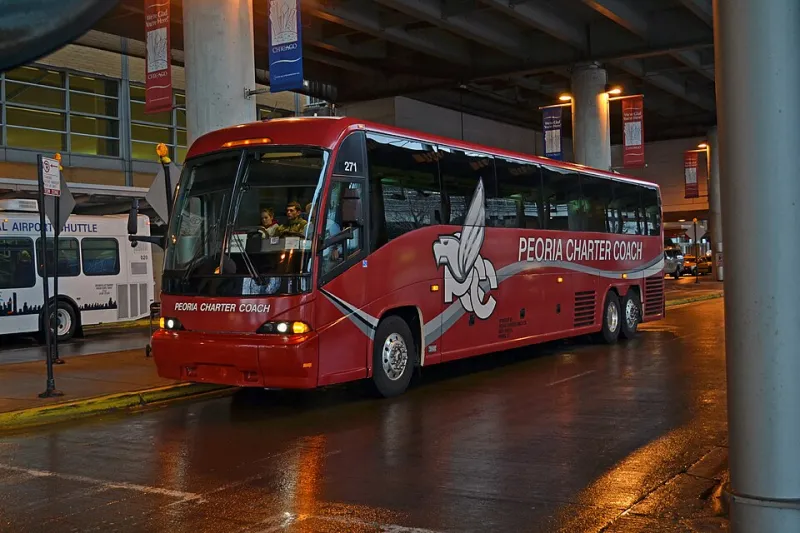
Photo: Peoria Charter Coach Company, CC BY-SA 4.0, via Wikimedia Commons
The parking lot behind Holy Trinity in Shenandoah, Pennsylvania, holds perhaps eleven cars on an ordinary Sunday. On the first Saturday of August, it holds a forty-five passenger charter bus, idling at midnight, its luggage bay already stuffed with folding chairs, icon stands, and coolers of kielbasa that some grandmother refused to entrust to anyone else.
The destination is the monastery shrine in the hills of upstate New York, nearly six hours away. The occasion is the feast of the Dormition. The passenger manifest: forty-one souls from a parish that, on paper, should not be able to afford the trip.
A Liturgy of the Road
Ask anyone who has ridden one of these buses and they will tell you the same thing: the pilgrimage begins long before the shrine gates. Around mile forty, someone produces a battery-powered lamp and a well-worn molitvenik, and the Akathist begins, sung in a Polish so old-fashioned it would raise eyebrows in Warsaw. The driver, a lapsed Catholic from Hazleton on his fourth annual run, has learned to take the curves gently during the refrains.
There is no formal rubric for the bus office. It has simply accreted over decades, the way parish customs do. The elderly in the front seats, where the ride is smoothest. The teenagers in back, nominally asleep, listening to everything. A thermos of coffee passed forward with the words "from Wanda" as if the thermos itself were the donor. Somewhere past Scranton, the singing softens into conversation, and the conversation becomes the real devotional work: stories of grandparents who made this same journey in a 1962 Ford station wagon, of bishops long departed, of the year the bus broke down outside Binghamton and the pilgrims held vigil on the shoulder, convinced it was penance.
The Arithmetic of Belonging
For small parishes — and Pennsylvania's anthracite country is full of them — the annual pilgrimage bus is not a program. It is a survival strategy wearing a devotional costume.
A congregation of thirty cannot sustain a full liturgical calendar with the richness larger jurisdictions take for granted. But for one weekend in August, those thirty faithful are not a struggling mission. They are a contingent, part of a current of Polish Orthodox life that flows from dozens of small towns toward a handful of great feast-day gatherings: the shrine pilgrimages, the cathedral feasts in Chicago and the New Jersey shore communities, the youth gatherings where, more than one marriage has quietly begun.
The bus returns them Sunday night with phone numbers, with choir arrangements photographed on smartphones, with the visible reassurance that they are not alone. Priests in isolated parishes will tell you, privately, that August attendance often rises in the weeks after the pilgrimage. The road, it turns out, is a form of evangelization.
Networks No Diocese Ever Planned
What is striking to an outside observer is how little of this system exists on paper. There is no national pilgrimage office. There is a web of parish secretaries who know which charter company gives the church rate, a Facebook group organized by a retired machinist in Bridgeport, and a longstanding custom that whichever parish hosts the feast sends its bus details to the others "as a courtesy."
Caravan groups fill the gaps. Families from the Dakotas who cannot justify a charter will instead drive to a midway point — a particular parish hall in Minneapolis with legendary pierogi — and continue in convoy. The routes are informal but remarkably stable, traced in marker on the same road atlases year after year.
Church historians have documented the great institutional structures of Orthodox America: the jurisdictions, the councils, the seminaries. Almost nothing has been written about the buses. Yet ask the faithful which institution has kept scattered Polish Orthodox communities connected to the wider Church, and many will point not to a chancery but to a man named Zbyszek with a clipboard and a cooler.
Where the Highway Becomes Holy Ground
There is a theology here, whether anyone has written it down or not. Pilgrimage has always been about displacement — the deliberate unmooring from home in order to encounter the sacred elsewhere. American life, with its interstate highways and its dispersed communities, has transformed that ancient practice into something distinctly our own: the overnight charter, the rest-stop blessing, the arrival at dawn with liturgy at nine.
The pilgrims themselves sense it. "On the bus, we are already at the shrine," one rider from Shenandoah put it, somewhere past the Delaware Water Gap, as the sun rose over the Poconos. "We just have to finish getting there."
For a tradition that survived partition, emigration, and everything the twentieth century could devise, that may be the most fitting image of all: the faithful on the move, singing in the dark, carrying their kielbasa and their icons toward one another.