A Marriage the Church Did Not Plan For: Polish Orthodox Families and the Anguish of Interfaith Unions

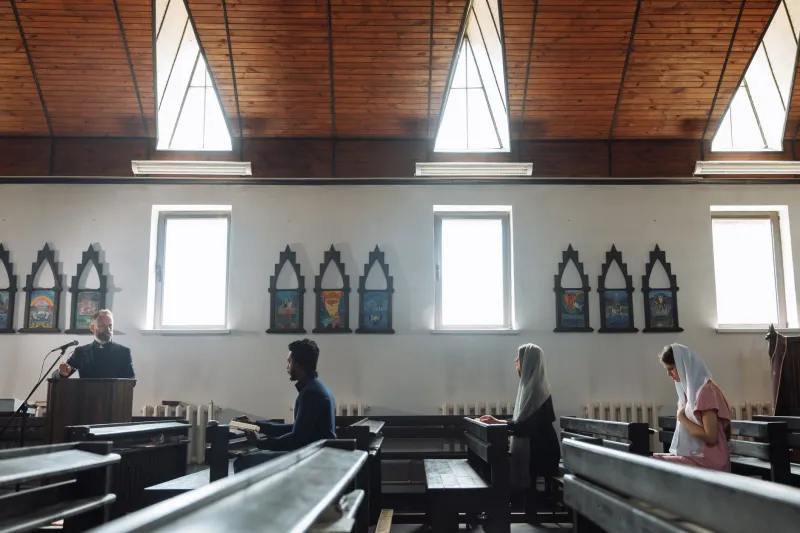
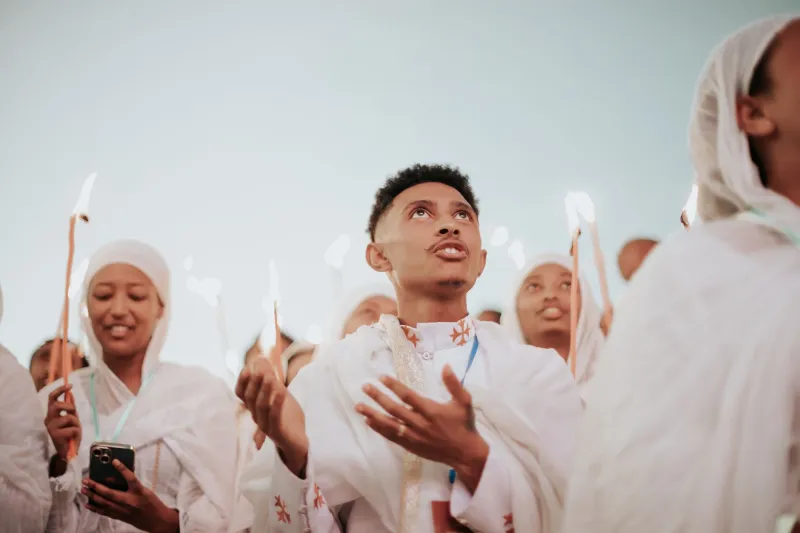
Photo: family wedding candles church diverse couple prayer ceremony, via ei-ph.rdtcdn.com
She was raised on the Divine Liturgy. She learned to fast before Pascha before she learned to ride a bicycle. Her grandmother, a woman who had carried icons across two borders and an ocean, pressed the faith into her hands like something irreplaceable. And then, at twenty-seven, she fell in love with a man who had been baptized Methodist and had not attended a Sunday service in a decade.
Her mother did not speak to her for three weeks.
This story, with its particular geography of devotion and rupture, is not rare among Polish Orthodox families in America. It is, increasingly, the norm. As Polish Orthodox communities have dispersed from their original ethnic enclaves into the broader American social landscape, as their children have attended secular universities, entered mixed workplaces, and navigated dating cultures with no ethnic or religious boundaries, the question of interfaith marriage has moved from the margins of parish concern to its center.
What the Tradition Teaches, and What American Life Presents
Orthodox Christian teaching on marriage is unambiguous in its aspirations. The wedding crowning — the rite at the heart of the Orthodox marriage ceremony — is not a legal formality but a theological event. Two persons are joined in a union understood to mirror the relationship between Christ and His Church. The home they establish is intended to be a domestic church, a little sanctuary where prayer, fasting, and sacramental life are woven into the fabric of daily existence.
This vision presupposes, naturally, that both spouses share the faith. When they do not, the domestic church becomes a contested space — not necessarily hostile, but theologically incoherent in ways that accumulate over time.
"The Church's position is not arbitrary," said one Orthodox priest who has counseled numerous interfaith couples in his New England parish. "It flows from a genuine understanding of what marriage is for. When we relax that standard — even with good pastoral intentions — we are not simply bending a rule. We are reshaping what the community understands marriage to mean."
Yet the pastoral reality confronting Polish Orthodox parishes is rarely so clean. Young Orthodox adults are not choosing between equally compelling suitors of different denominations. They are falling in love with specific human beings in the specific circumstances of American life — circumstances that the Church's theology did not design and cannot simply dismiss.
The Parents in the Middle
For Polish Orthodox parents, the arrival of an interfaith relationship in their family is rarely experienced as an abstract theological problem. It is experienced as a crisis of loyalty, love, and identity — all arriving simultaneously.
"You love your child more than anything," said one mother in New Jersey whose daughter is engaged to a man of no religious affiliation. "And you also know, in your bones, that what she is walking into is going to cost her something. You have seen it happen. You have watched the faith drain away, quietly, over years. And you cannot say that out loud without sounding like you are against her happiness. So you carry it."
This emotional complexity — the simultaneous holding of parental love and theological conviction — is a defining feature of how Polish Orthodox families actually navigate these situations, as opposed to how they are sometimes portrayed in both progressive and traditionalist narratives. Very few of these parents are simply rejecting their children. Very few are simply acquiescing. Most are attempting something considerably harder: remaining in relationship with a child whose choices they cannot endorse while refusing to pretend that those choices carry no consequences.
Pastors who work closely with these families speak of the need for parishes to provide genuine support for parents in this position — not merely doctrinal instruction, but the kind of sustained pastoral accompaniment that helps them hold the tension without either capitulating to it or fracturing under it.
The Question of Children
If the initial interfaith marriage is the first crisis, the question of how children will be raised is invariably the second — and frequently the more consequential one. Polish Orthodox grandparents who have made peace, however painfully, with a son-in-law's Lutheranism or a daughter-in-law's religious indifference find themselves confronted anew when the first grandchild arrives.
Will the child be baptized? In which tradition? Will they attend Divine Liturgy? Will they learn Polish? Will they know the saints by their Polish names? Will they fast before Pascha? The answers to these questions, negotiated between two people who may have very different levels of investment in their respective traditions, determine whether the Polish Orthodox faith survives into the next generation within that family — or quietly disappears.
The statistical picture, while imprecise, is not encouraging. Research on religious retention in mixed-faith households consistently finds that the absence of unified parental commitment to a single tradition correlates with lower rates of adult religious practice in children. For a community already navigating the pressures of assimilation, the multiplication of interfaith households represents a compounding challenge.
"I watch my grandchildren," said one grandfather in Illinois, a man who has attended the same Polish Orthodox parish for sixty years. "They are wonderful children. But they do not know what they are. Nobody has told them. And nobody is going to tell them, because telling them means one parent winning and the other parent losing. So the faith just waits, and the children grow up without it."
Navigating Without a Map
What Polish Orthodox parishes have not yet developed, in most cases, is a coherent pastoral strategy for accompanying interfaith families — one that is neither dismissive of theological seriousness nor indifferent to the human complexity of these situations. Individual priests do this work with varying degrees of skill and compassion. Institutional frameworks remain underdeveloped.
Some parishes have begun hosting conversations — not formal programs, but honest gatherings — where families navigating interfaith marriages can speak plainly about what they are experiencing. These conversations, by several accounts, have been unexpectedly fruitful. Parents discover they are not alone. Young couples find that naming the tension reduces it slightly. Grandparents learn that their grief, properly expressed, can be received rather than merely endured.
The Polish Orthodox tradition has always understood the family as the primary site of faith transmission. It has also always understood that love — including parental love, including marital love — is not a simple thing. The challenge now before these communities is to hold both truths at once: to take the theological stakes of marriage seriously without treating the families caught in this tension as casualties rather than as people in need of the Church's most careful pastoral attention.
The woman whose mother did not speak to her for three weeks eventually married her Methodist fiancé. He began attending Divine Liturgy with her, out of love rather than conviction. Their first child was baptized Orthodox. The grandmother, who had carried icons across two borders, held the child at the font.
Grace, as the tradition has always insisted, moves in ways that no pastoral strategy fully anticipates.