Sacred Plates: How Polish Orthodox Culinary Traditions Are Finding a Home at the American Table
In a modest home in Parma, Ohio, the kitchen fills with the scent of mushroom broth and poppy seed pastry every Christmas Eve. Three generations of the Kowalczyk family gather around a table set with hay tucked beneath the linen tablecloth — a reminder of the manger — and twelve meatless dishes prepared according to customs their great-grandparents carried from eastern Poland. This is not a museum recreation. It is a living act of faith.
Across the United States, Polish Orthodox families are doing something quietly remarkable. They are introducing their liturgical food customs — born from centuries of Eastern Christian fasting discipline and festive celebration — into households that may otherwise know only the secular rhythms of Thanksgiving turkey and Christmas ham. The result is a slow but meaningful reshaping of what the American holiday table can look like, and what it can mean.
The Theology on the Table
Orthodox Christianity has always understood food as a spiritual matter. The liturgical calendar governs not merely what is prayed but what is eaten — and when. Fasting periods, which occupy a significant portion of the Orthodox year, call the faithful to abstain from meat, dairy, fish, oil, and wine on prescribed days. These are not mere dietary restrictions. They are bodily disciplines intended to orient the soul toward prayer and repentance.
For Polish Orthodox communities — many of whom trace their heritage to the Lemko, Boyko, and Podlasie regions of historical Poland — these fasting and feasting customs arrived in America alongside the immigrants themselves. The Nativity Fast, which precedes Christmas, and the Great Lent, which precedes Pascha, structured the domestic year as surely as any church calendar printed in the parish hall.
Anna Petryk, a third-generation Polish-American living in Pittsburgh, Pennsylvania, describes the twelve-dish Christmas Eve supper — known in Polish as Wigilia — as the single most theologically dense event in her family's year. "Each dish has a reason," she explains. "The kutia, the wheat berry pudding with honey and poppy seeds, represents the dead and the resurrection. The borscht and the mushroom pierogi represent the fast. You're not just eating. You're praying with your hands and your stomach."
Fasting Foods in a Fast-Food Nation
Introducing Orthodox fasting cuisine to American friends and neighbors is not without its challenges. The United States, for all its diversity, has largely absorbed food culture through the lens of convenience and abundance. The idea that a family might voluntarily forgo meat and dairy for weeks at a time — not for health trends, but for God — strikes many Americans as unusual at best.
Yet it is precisely this distinctiveness that has made Polish Orthodox food customs a point of genuine curiosity. Second-generation families report that bringing a pot of żurek — a sour rye soup — to a neighborhood potluck, or offering homemade chrusciki at an office gathering, often opens conversations about faith that might never have occurred otherwise.
Father Aleksander Nowak, a parish priest in the Diocese of the Orthodox Church in America serving a predominantly Polish-heritage congregation in New Jersey, has observed this phenomenon directly. "Food is pre-apologetic," he says with quiet conviction. "Before anyone asks why we fast, they taste what we eat during the fast. And it is beautiful food. It is honest food. It makes people curious about the life behind it."
His parish has begun hosting annual pre-Lenten and pre-Nativity dinners open to the broader community, presenting traditional fasting dishes alongside brief explanations of their theological significance. Attendance has grown steadily each year.
The Easter Basket as Catechism
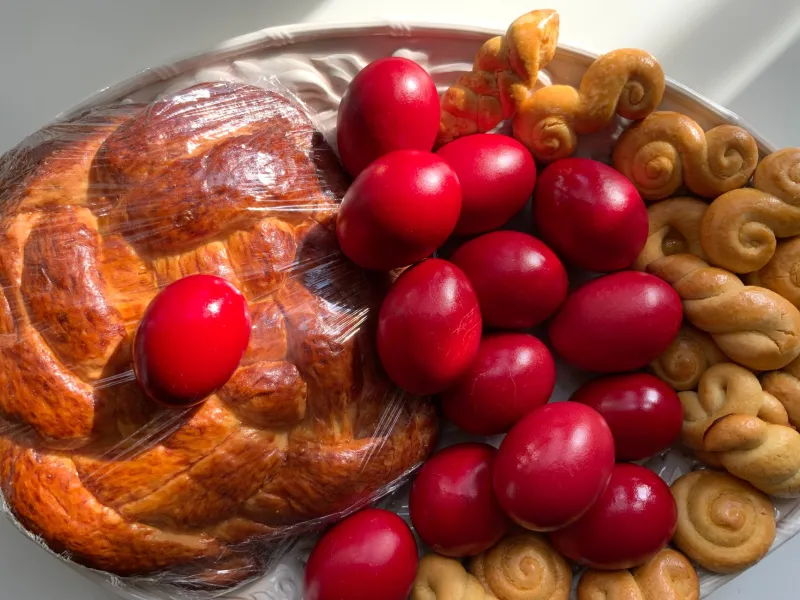
Perhaps no Polish Orthodox food tradition has attracted more American attention than the blessing of the Easter basket, known as Święconka. On Holy Saturday, families bring to church a basket filled with symbolic foods: a decorated egg representing the resurrection, smoked sausage representing the joy of feasting after the fast, bread representing Christ as the Bread of Life, horseradish representing the bitterness of sin, and salt representing preservation and covenant.
The priest blesses these foods, and they are consumed on Pascha morning after the all-night Resurrection liturgy — the first foods eaten after the Great Fast concludes. For many Polish-American families, the basket is their most visible and shareable tradition, one that photographs well and travels easily into conversations with non-Orthodox neighbors.
Maria Jabłońska, whose family has attended a Polish Orthodox parish in Chicago for three generations, began posting photographs of her family's Święconka basket on social media several years ago. The response surprised her. "People wanted to know what everything meant. I ended up writing a long explanation and sharing it, and it got passed around far beyond my friends. People were genuinely moved by the idea that every item in the basket was a sermon."
Anchors in a Secular Current
Beyond their evangelizing potential, these food traditions serve a deeply personal function for Polish Orthodox families navigating an increasingly secular American culture. In households where younger generations may feel the pull of assimilation, the kitchen often becomes the last stronghold of religious identity.
Magdalena Wiśniewska, a mother of four in Minneapolis, Minnesota, is deliberate about this. She teaches her children not merely to cook the traditional dishes but to understand their spiritual context. "If my daughter knows why we don't eat meat on Wednesdays and Fridays, and she knows how to make a proper beet soup for Christmas Eve, she carries the faith in her body," she says. "That is harder to lose than an idea."
This embodied transmission of faith — through smell, taste, labor, and ritual — is something Orthodox theology has long affirmed. The body is not incidental to spiritual life; it participates fully in it. Polish Orthodox food customs are, in this sense, not cultural nostalgia but active theology.
A Tradition Worth Sharing
The influence of Polish Orthodox culinary heritage on the American holiday table is not a conquest or an imposition. It is an invitation — extended through hospitality, through generosity, through the simple act of sharing food prepared with prayer and intention. As more Americans seek meaning in their celebrations and yearn for traditions that carry genuine weight, the Polish Orthodox kitchen offers something rare: a table where every dish has a story, and every story points toward God.
For families like the Kowalczyks in Ohio, the twelve-dish supper is not merely a custom to be preserved. It is a gift to be offered — to children, to neighbors, and to a nation still learning what it means to gather in sacred fellowship.