Stones That Still Speak: Reading a Century of Faith in Polish Orthodox Cemeteries
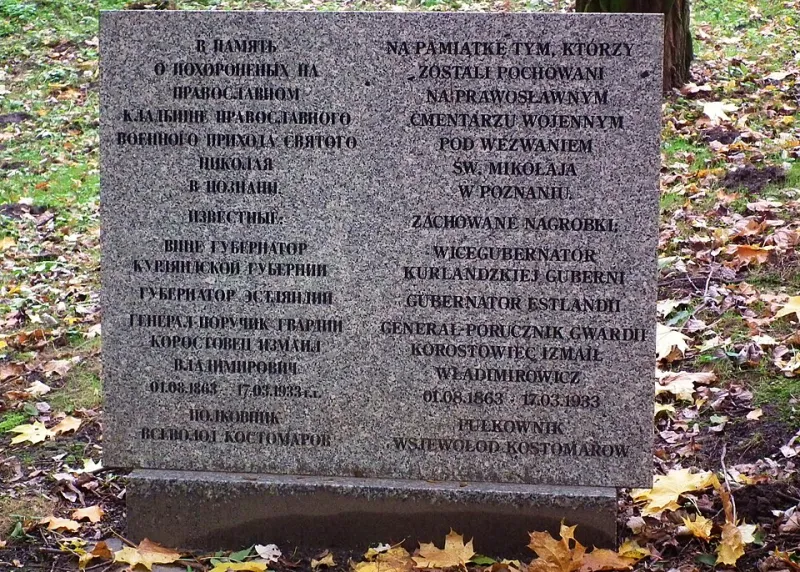
Photo: MOs810, CC BY-SA 4.0, via Wikimedia Commons
The cemetery behind Holy Trinity Orthodox Church in Centralia, Pennsylvania, does not look like an archive. There are no climate-controlled vaults, no filing cabinets, no index cards. There is only a hillside of weathered limestone and granite, rows of double-barred crosses tilting gently eastward, and the names of the founding generations of Polish Orthodox America carved in letters that frost heaves and acid rain are slowly erasing.
And yet, walk that hillside with the parishioners who tend it, and you will understand more about a hundred years of Orthodox faith in America than any archive could teach.
A Parish Written in Granite
Dr. Marek Sobolewski, a retired professor of Slavic studies who has spent five summers photographing the stones, calls the cemeteries "the only parish records that never lied." Baptismal registers could be lost in a basement flood; immigration papers could be forged; but a gravestone, he says, records exactly what a family wanted remembered.
What the stones record is striking. The earliest markers, dating from the 1890s through the First World War, are almost entirely in Polish Cyrillic or Latin-script Polish — evidence of families who crossed the ocean but not the language. By the 1930s, bilingual epitaphs appear: Polish on the face, English on the reverse, a literal translation of a community living between two worlds.
"You can watch Americanization happen in real time," Sobolewski explains, standing beside a 1937 marker bearing both "Wieczny odpoczynek" and "Eternal Memory." "The stonecutter charged by the letter, and families paid for two languages. That was a theological decision as much as a financial one."
The Double Cross and the Domestic Details
Certain motifs recur across the Polish Orthodox burial grounds of the anthracite coal towns and the Connecticut mill cities. The three-barred Orthodox cross appears on nearly every pre-war stone, often carved by the same itinerant masons who served multiple parishes along the rail lines. Wheat sheaves and grape clusters — Eucharistic imagery — mark the graves of devout communicants. And on the stones of women, one frequently finds a small carved candle or lamp, a quiet testimony to lives spent keeping the vigil light burning at home.
In Windsor, Connecticut, where a Polish Orthodox congregation dates to 1913, the cemetery holds an entire row of infants lost in the influenza winter of 1918–19. The parish's ladies' guild still decorates that row every Theophany with evergreen boughs, a custom no one has documented but no one questions.
"My grandmother showed me which graves to tend before she showed me how to make pierogi," says Helen Dakowski, 68, who coordinates the annual spring cleanup. "The cemetery is the parish. The church building is where we pray, but this is where we belong."
Racing the Weather
The urgency is real. Limestone softens; sandstone spalls; and the marble popular with interwar stonecutters dissolves letter by letter under a century of American acid rain. Several markers in the Illinois parishes have already become illegible to the naked eye.
A loose coalition of parishioners, seminarians, and amateur genealogists is working against the clock. Using reflective lighting photography — raking a flashlight across a stone at dusk to make worn letters cast shadows — volunteers have recovered inscriptions invisible in direct sunlight. Others are transcribing parish burial registers and cross-referencing them with the stones, creating records that will survive even when the granite does not.
The work carries a distinctly Orthodox resonance. The Church prays for the departed by name at every Liturgy; a name that cannot be read is a name that cannot be commemorated. Preservation, in this light, is not antiquarian sentiment. It is intercession.
What the Dead Would Ask of Us
The founding generations who lie beneath these hillside crosses came to Pennsylvania coal camps and Connecticut factories with almost nothing, built parishes with their wages, and asked to be buried within the sound of the bell. Their descendants, scattered to the suburbs, return on Memorial Day and occasional Sundays.
The stones ask a simple question of the living: will the next century of Polish Orthodox faith in America be legible? The answer is being written now — in parish registers kept or lost, in cemeteries tended or abandoned, in a heritage either handed on or left to the rain.
As Sobolewski puts it, packing up his camera at dusk: "They kept the faith. The least we can do is keep the names."