Throttle and Thurible: The Case for Blessing the Machines Americans Actually Drive
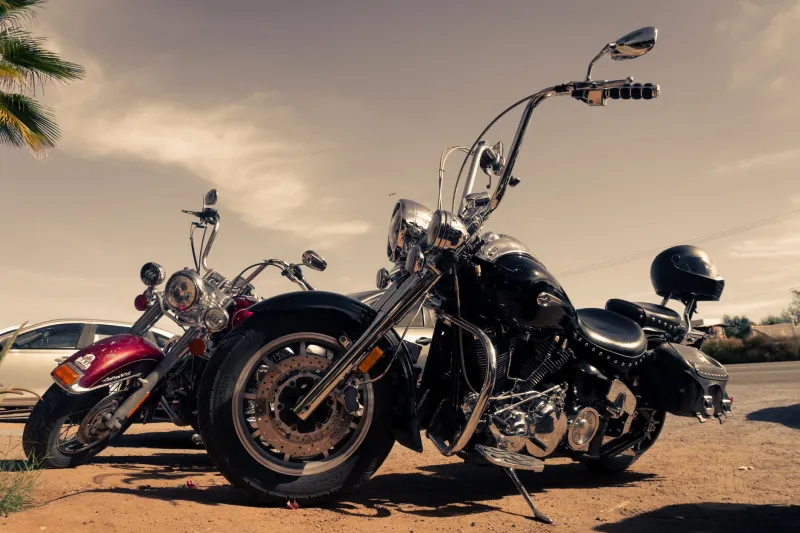
Each spring, a handful of Polish Orthodox parishes in this country do something that would look, to a certain kind of liturgical purist, like a stunt. They set up a table in the parking lot. They put out a bowl of holy water and a sprinkler. And they bless motorcycles.
The photographs circulate. Leather vests, embroidered patches, a priest in a cassock with a towel over his arm, a chrome exhaust pipe catching the light. Someone's aunt brings pierogi. Somebody's Harley gets a ribbon.
It is easy to be cynical about this. It is also, I would argue, a failure of nerve — and a failure to read the country we actually serve.
The Machine as a Fact of Life
Consider, soberly, what the average American household possesses. Not a horse, not a field, not a well. A car. Often two. A pickup that doubles as a work vehicle and a family van. A motorcycle kept for the six good weeks of a northern summer. A lawn mower, a snowblower, a riding mower that a retired man maintains as a small act of dignity.
These are not hobbies. They are the conditions of livelihood. The plumber's truck is how the plumber's children eat. The car that takes a night-shift nurse across three counties is the difference between work and destitution in places with no bus line. A blessing of vehicles is not a blessing of toys. It is a blessing of the machinery by which Americans earn bread.
And the Church has always blessed the tools of labor. She blesses fields, boats, bees, seeds, wells, and bread. The notion that the internal combustion engine is somehow beneath the reach of holy water is not a theological insight; it is a class prejudice in liturgical clothing.
The Skeptic's Real Objection
Let me grant the skeptic the strongest version of his case. He says: the blessing of the bikes draws crowds who come for the spectacle, not the sacrament; it turns the parish into a backdrop; it is evangelism by gimmick, and gimmicks do not produce converts.
There is truth in the first two and less in the third.
The blessing of vehicles is a sacramental — a blessing, not a mystery — and the Church has never pretended that a blessing magically produces faith in the recipient. It is an act of the Church toward the world, declaring that this object and this labor are not outside God's care. What it does for the person standing there with a helmet under his arm is between him and God.
What it does for the parish, however, is observable. It puts the priest outdoors, on neutral ground, at a time when the neighbor is not required to enter anything or know anything. It gives a man whose only relationship to Orthodoxy is a Polish grandmother and a remembered Christmas Eve an hour of contact that involves no doctrinal exam and no parking problem.
In parishes from the industrial towns of Pennsylvania to the Polish neighborhoods of the upper Midwest, priests who have run these blessings consistently report the same sequence: the first year, mostly parishioners' bikes. The second year, a few neighbors. The third year, a man who keeps coming back and eventually shows up on a Sunday in October, sits in the back, and stays for coffee.
That is not a gimmick. That is how the Church has always reached people — through the stuff of their lives.
A Checklist for the First Blessing
If a parish is going to do this, it should do it well. A careless blessing is worse than none, because it teaches the neighborhood that the parish does things carelessly.
Set the date in the calendar, not in the parking lot. Choose the day, publish it early, and put it on the parish's public schedule. A blessing that materializes by rumor cannot be attended.
Coordinate with the civil authorities. A motorcycle procession requires route notice, police coordination in most municipalities, and a safety marshal with a vest and a radio. Do not improvise traffic.
Bless, do not sell. Have a table for water, ribbons, and a printed prayer card. Have a separate table, at a distance, if the parish must raise funds through food. Keep the two visually distinct, so that no one can say the Church charged admission to a blessing.
Prepare the text. Use the approved order for the blessing of a vehicle, read it clearly, and do it in both languages if the parish lives in both. Do not abbreviate the prayers to get to the parking lot faster.
Brief the greeters. Assign two people whose only job is to welcome strangers, learn names, and answer the question every visitor has: when are your services?
Follow up within the week. A photograph sent to the participants, an invitation to the patronal feast, a note to the man who asked about baptism. The blessing is an opening; openings must be tended.
Protect the Lord's Day. Schedule the blessing so that it does not displace the Divine Liturgy, shorten the homily, or turn the morning into logistics. If the parking lot has begun to organize the temple, the parish has already lost the argument.
The Danger of the Spectacle
There is a real hazard, and it is not the one the purists worry about. The danger is that the parish begins to love the crowd more than the Liturgy, that it measures its health in photographs, and that it slowly converts into an event venue with an icon corner.
The remedy is not to cancel the blessing. The remedy is proportion. The blessing of bikes is one Saturday. The Divine Liturgy is every Sunday. A parish that keeps that ratio clear can bless every machine in the county without harming itself a whit.
What We Are Actually Doing
When the priest walks down a line of twenty motorcycles in a church parking lot and stops at each one, he is making an astonishing claim. He is saying that this object — this ordinary, greasy, depreciating, American object — will be used by its owner for labor, for mercy, for the transport of children and the sick, and that the Church asks God to sanctify that use.
He is also saying something to the parishioners in their cars and their work vans, who drive past the lot on Monday and remember that someone prayed over the thing that keeps the lights on.
Holy water on a chrome fender is not a gimmick. It is the same instinct that once led our grandfathers to bring seed, and bees, and bread to the porch of a wooden church in Podlasie. The machines changed. The porch is still there.